


Aquatic Wheelchair
0 Comments Published by Jon Mikel Iñarritu January 24th, 2007 in Med Gadgets, NewsAn aquatic wheelchair that helps people in rehabilitation process (i.e. amputations) was created by students of the National Polytechnical Institute, Berenice Nieto Ávila and Miguel Ángel Herrera Ruiz.
This amphibious technology allows physiotherapists to do their job in a better environment and with less risk. It offers comfort, security and efficiency for the patients.
The structure of this device was made of nickel, floaters of polystyrene covered with fabric nylon and a mechanism that allow the necessary movements so that the patient can enter the bathtubs or pools, with no need of aid.
“With this chair the patient can move by himself without fear to sink or to hurt himsellf”, Miguel Ángel Herrera emphasized.
The approximated weight of the chair within the water is of 15 kilograms (30 pounds approx) and supports a maximum weight of 150 kilos (300 pounds approx).
The creators will start a company dedicated to design, constructe and implement this kind of devices, focusing in rehabilitation techniques. At the moment they look for financing to commercialize their product and other innovations of rehabilitation field. The amphibious wheelchair obtained the first place of the Seventh Encounter of Entrepreneurs.
Mexican medstudents learn with robots
0 Comments Published by Jon Mikel Iñarritu January 24th, 2007 in Med Gadgets, News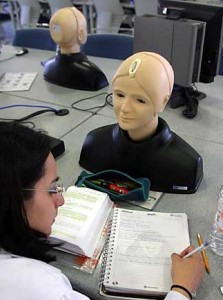
They are patients in a hospital, but they don’t suffer, because they are robotized models that allow students to learn without having the consequences of a real medical emergency.
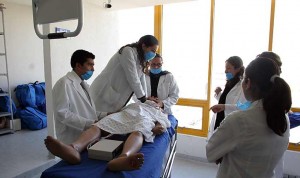
It’s been a year since the beginning of the Certification and Training Center of Medical Aptitudes in the Medicine Faculty of the UNAM, 179 robots have served 19,496 students to solve urgencies: from acute coronary syndromes to high risk childbirth.
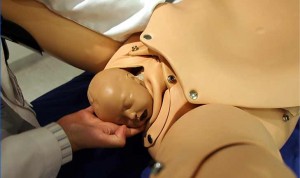
“If they don’t do it right, the patients will “die”, and this is reflected in a real EKG”, said doctor Jose Alberto García Aranda, coordinator of the CECAM.
Prosthetic Arm developed by a Mexican engineer
6 Comments Published by Jon Mikel Iñarritu January 24th, 2007 in Med Gadgets, News
An articulated prosthesis that reproduces the seven basic movements of the human arm, using the electrical impulses of the human body, was developed by a student of the National Polytechnic Institute (Instituto Politécnico Nacional).
Simón Guerrero Castillo, who in in December finished his Engineering in Communications and Electronics career, will obtain its title with this device, which is formed by three adaptable modules at different levels from amputation, is light and tries to be of low cost, because it is done with mexican and easy to obtain components.
“The arm works with microelectrical signals that generates the body, which are registered by a group of 22 to 26 electrodes that are placed in a customized shoulder reinforcement according to the stature of each patient. This electrodes switch-on the commands of execution of the arm to control variables like position, speed and pressure”, details Simón Guerrero, of 25 years.
He constructed this single prototype, in its house and with an investment of $18,000 pesos ($1,800 dlls.)
The movements of this device are very similar to the natural ones: wrist (left, right, up, down); turn of the forearm; rotation of the forearm; elbow and shoulder (elevation, up, down); opening and closing of the hand. These movements are made with nine small motors that operate with two nickel-cadmium batteries of 12 volts.
“My main motivation is to make a prosthesis that helps people in Mexico and that it has an accessible price, because unfortunately many arm amputations are suffered by people of low income that cannot pay a nice prosthesis”.
In order to install the arm to the patients surgery is not required.
Electrocardiogram on laptop
1 Comment Published by Jon Mikel Iñarritu January 4th, 2007 in Medlinks, News
A robot gives birth
1 Comment Published by Jon Mikel Iñarritu January 4th, 2007 in Humor, Medlinks, News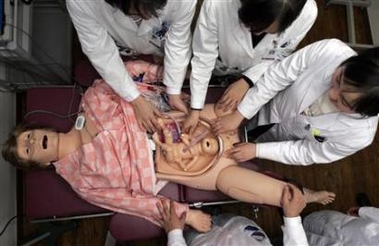
Medical students practice parturition treatment with a baby-delivery robot at an obstetrician class of Kyung Hee university medical center in Seoul December 27, 2006.
The medical center imported the robot to give more chances of practical delivery treatment for students as South Korea’s birth rates are constantly falling, a professor of the class said.
Feliz Navidad y Próspero Año Nuevo
1 Comment Published by Jon Mikel Iñarritu December 22nd, 2006 in Site
I will be offline until January 2nd, and
I would like to wish all of you, dear readers that you find yourself next to your loved ones in this Christmas, and have a healthy and successful New Year!

Best of all,
Jon
Soriano’s Surgical Retractor in-action
2 Comments Published by Jon Mikel Iñarritu December 22nd, 2006 in Medical ImagesThis is the previously patented surgical retractor developed by Dr. Ángel Raúl Soriano Sánchez (Mexican Ob/Gyn from the National Institute for Social Security - IMSS) in action.
This amazing invention looks useful, isn’t it?
Surgeon stoped at airport with his bloody bag
3 Comments Published by Jon Mikel Iñarritu December 22nd, 2006 in Humor, NewsA christchurch surgeon in a post-op rush has sparked a bloody bag at Queenstown Airport. Local medical minister of health Dr. Derek Bell intends referring the incident to the New Zeland Medical Council – he says it was reported to him “there was a blood stain on the bag that was increasing in size”.
Peter Walker, the surgeon who tried to check in his blood-stained laundry bag as hold luggage last Thursday afternoon, told Mountain Scene “diluted watery blood stained the bottom of the sack”.
Walker admits the baggage contained a plastic bag full of used surgery gowns, a blood-soaked towel and surgical instruments in steel trays. Walker denied that the instruments posed a danger, saying they were inside steel trays.
Walker said he always asks patients beforehand if they have infectious conditions like HIV infection or hepatitis. “I knew there was no infectious material at all” He said.
“I only had 10 minutes to spare to get to the airport and, as I was going to load the bag into the car, I said, ‘Oh, there’s a patch of blood-stained water’.”
More here
Hands transplantation
3 Comments Published by Jon Mikel Iñarritu December 14th, 2006 in Medical Images, News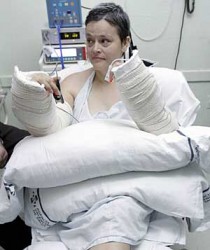
A 47 years old woman had both hands amputated 28 years ago. Now she is the first patient in Spain to receive a transplant of both forearms and hands.
This operation was done in La Fe Hospital in Valencia, Spain by the team of hand surgery of the Pedro Cavadas’ Foundation.
This is the 7th similar surgical procedure in the world and the first performed in a woman.
The patient will recover part of her sensibility in a period between five and six months.
Pasteur Institute in Latinamerica opens its gates
0 Comments Published by Jon Mikel Iñarritu December 10th, 2006 in NewsThe prestigious Pasteur Institute opeded its gates the past Friday in Montevideo, Uruguay.
“The Institute will be the state-of-the-art and the best of science investigation with the newest methods, methods which explore and try to explain the miracle of life”, said Tabaré Vázquez the president wich is an oncologist.
Mesothelioma brief review
3 Comments Published by Jon Mikel Iñarritu November 29th, 2006 in Fast Facts, Medlinks, ReviewThis is a paid review
Mesothelioma Aid is a site for practical living with malignant mesothelioma. In addition to medical information, mesothelioma patients, their families, and their caregivers need support with real life and mesothelioma caregiving issues. Mesothelioma Aid’s focus is on providing answers to your questions and helping you best cope with what is ahead.
Fast Facts
Mesothelioma is an insidious neoplasm arising from the mesothelial surfaces of the pleural and peritoneal cavities, tunica vaginalis, or pericardium. 80 percent of this cases are from pleural origin. The major risk factor for malignant mesothelioma is inhalation of asbestos.
Since asbestos inhalation is the main risk factor, it’s considered as an occupational disease. The incidence in the U.S. is estimated to be 2,200 cases per year.
Asbestos is valued in industry for its resistance to heat and combustion and it’s still used in cement, ceiling and pool tiles, automobile brake linings, and in shipbuilding.
As many as eight million living persons in the U.S. have been occupationally exposed to asbestos over the past 50 years. Those workers in contact with asbestos are at significant risk for the development of both non malignant and malignant pulmonary disease.
Clinical Presentation
Malignant pleural mesothelioma most commonly presents in the 5th to 7th decades of life. A large proportion of patients diagnosed at an earlier age have a history of childhood exposure to asbestos.
The most frequent presenting symptoms of pleural mesothelioma are dyspnea (difficulty in breathing) and nonpleuritic chest pain. Rarely, asymptomatic patients present with a unilateral pleural effusion that is found incidentally on routine chest radiograph.
Common physical findings at the time of diagnosis include unilateral dullness to percussion at the lung base, palpable chest wall masses, and scoliosis towards the side of the malignancy.
Clinical course
This neoplasia exerts its morbidity and mortality via inexorable local invasion. Patients typically develop shortness of breath and chest pain as the tumor gradually obliterates the pleural space and replaces any pleural fluid. Local invasion of crucial thoracic structures can result in one or more of the following complications:
The survival of patients with mesothelioma is between 6 and 18 months, and is not significantly affected by currently available therapeutic interventions.
With a brief review of this disease we can see that this isn’t a benign disease, that’s why I strongly recommend patients, their families, and their caregivers to visit Mesothelioma Aid for questions and support.
Related Link: Mesothelioma
Grand Rounds 3.10
0 Comments Published by Jon Mikel Iñarritu November 29th, 2006 in Medlinks, Grand RoundsAn outstanding edition of this week’s Grand Rounds is up at Notes from Dr. RW.
Sit down and read the best of the medical blogsphere.
An oldman is declared dead by his odor
2 Comments Published by Jon Mikel Iñarritu November 28th, 2006 in Humor, News
Because of the stinky scent of his house and his absence in the streets nine days ago, neighbors of a mexican state called Aguascalientes, paramedics declared Jose Luis González dead.
When paramedics opened the house were repelled by the bad odor and a dog, so they could only see the man underneath a table, and without reviewing it, they concluded that regarding the strong scent, the man was dead.
They called then to the crime experts and when they began to manipulate the “corpse” to make corresponding managements, the body began to move, protesting their presence in his place.
González was transferred to the “Hospital Hidalgo”, where hypothermia and dehydration signs were detected, he was admitted to the hospital and now his state of health is reported as stable, according to sources in that hospital.
Corpus Delicti a nice play
1 Comment Published by Jon Mikel Iñarritu November 26th, 2006 in Medical Images, Medlinks
Corpus Delicti refers to crime’s body, not just to the corpse itself but to the related body of evidence.
I would love to see this play wich is a free play that uses real-life ballistig gel cadaver to explore art & science of anatom as practiced in Holland during the Age of Enlightenment, and immortalized in Rembrandt’s 1632 painting “The Anatomy Lesson of Dr. Tulp” (one of my favorites paintings).
In Corpus Delicti: Just Desserts, the protagonist is Dr. Nicholas Tulp (Larry Underwood), guides audiences through the taboo territory of the body’s interior, inviting them to witness the dissection of a life-sized cadaver made up of ballistic gel and vegetables as internal organs.
A “post-mortem” panel discussion with researchers, ethicists, artists and members of the cast will be held after the performance.
The play is produced by Local Infinities Visual Theater. I accept invitations.

Recent Comments