


Laparoscopic vs Conventional Nissen fundoplication
5 Comments Published by Jon Mikel Iñarritu July 19th, 2006 in Medical JournalFrom Annals of Surgery
A randomized trial that compares (subjectively and objectively) the laparoscopic versus conventional Nissen fundoplication in 5 years.
The comparision was made with 148 (79 laparoscopic vs 69 patients who were requested to fill in a questionnarie and to undergo esophageal manometry and 24 hours pH-metry.
Results: At 5 years follow-up, 20 patients had undergone reoperation: 12 after laparoscopy (15%) and 8 after conventional (12%). There was no difference in subjective outcome, with overall satisfaction rates of 88% (lap) and 90% (conv). Total esophageal acid exposure times (pH < 4) were 2.1% +/- 0.5% and 2.0% +/- 0.6%, respectively (P = 0.21). Antisecretory medication was taken daily in 14% and 16%, respectively (P = 0.29). There was no correlation between medication use and acid exposure and indices of symptom-reflux association. No significant differences between subjective and objective results at 3 to 6 months and results obtained at 5 years after surgery were found.
It concludes that the effects of laparoscopic and conventional are sustained up to 5 years and the long-term results are comparable. A substantial minority of patients in both groups had a second antireflux operation or took antisecretory drugs, although the use of those medications did not appear to be related to abnormal esophageal acid exposure.
I think laparoscopic approach is clearly superior due to the recuded hospital days and short convalescence period.
Regards,
Dr. Jon Mikel Iñarritu
Biomedical Image Awards
1 Comment Published by Jon Mikel Iñarritu July 19th, 2006 in Medical Images, MedlinksVia MAKE; from wellcome trust
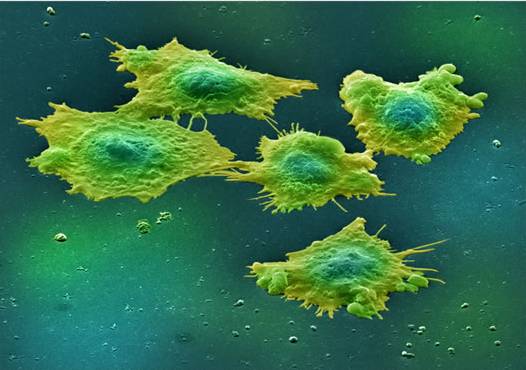
In a lovely contest called Biomedical Image Awards 2006 I have found this image of human colon cancer cells in culture.
Look how beautiful, but how bad when a patient has it.
Regards,
Dr. Jon Mikel Iñarritu
Intussusception
0 Comments Published by Jon Mikel Iñarritu July 17th, 2006 in Fast Facts, Medical ImagesIntussusception is the invagination of a part of the intestine into itself, in other words is the prolapse of one part of the intestine into the lumen of an immediately adjoining part. It is the most common abdominal emergency in early childhood.
Epidemiology: Most episodes of intussusception occur in otherwise healthy and well-nourished children. Approximately 60% of children are younger than one year old, and 80 percent are younger than two. Is the most common cause of intestinal obstruction in children between 3 months and 6 years old. It appears to have a slight male predominance with a male:female ratio of approximately 3:2.
Etiology: The vast majority of cases is unknow. Another causes are Meckel’s diverticulum, polips, intestinal tumors, Henoch-Schönlein purpura, strange bodies, etc.
The most common form of this disease is the ileo-colic and ileo-ileo-colic invaginations. It could be associated with the rotavirus vaccine.
Clinical picture: Acute onset of intermittent, severe, crampy, progressive abdominal pain, accompanied by inconsolable crying and drawing up of the legs toward the abdomen. This painfull episodes occurs at 15 - 20 minute intervals and then become more frequent and severe. Vomiting may follow episodes of abdominal pain.
This episodes can be followed by vomiting and the passage of “currant jelly” stool (a mixture of blood and mucous). A sausage-shaped abdominal mass may be felt in the right side of abdomen. The prevalence of blood in the stool is as high as 70% if occult blood is included.
Diagnosis: It is based on index of suspicion, frequently the diagnosis is stablished with contrast studies (wich could be also therapeutic).
The abdominal plain film (see below) may be helpful because they may show frank intestinal obstruction or massively distended loops of bowel with absence of colonic gas.

The ultrasound can be useful also, with a sensitivity and specificity approach 100%. The classic finding is a “bull’s eye” or “coiled spring” lesion (see below) representing layers of the intestine within the intestine.

Treatment: Nonoperative reduction using barium or air contrast techniques is successful in approximately in 75 - 90% (in the first 24 hours) of patients with ileo-colic intussusception.
Surgery is indicated when nonoperative reduction is incomplete or when a persistent filling defect, indicating a mass lesion is noted. Broad-spectrum intravenous antibiotics should be given before surgery. Manual reduction at operation is attempted in most cases, but resection with primary anastomosis needs to be performed if manual reduction is not possible or if a lead point is seen.
Regards,
Jon Mikel Iñarritu, M.D.
Cervical Cancer Vaccine (gardasil)
10 Comments Published by Jon Mikel Iñarritu June 15th, 2006 in NewsFDA approves the fist vaccine for cervical cancer, a week ago, the vaccine was aprooved in Mexico. With the name of Gardasil, and a cost of US$120.00/dose (2 doses to complete the treatment), I celebrate this effort against cancer.

Here in Mexico, cervical cancer is by far, the most common type of cancer (24.4%) in general population (including males). In females, again is the most common type of cancer (36%). The most common risk factor is infection from human papillomavirus (HPV).
This virus causes cervical cancer, precancerous genital lesions and genital warts; the vaccine prevents against HPV types 16, 18 (causes 70% of cervical cancer cases); 6 and 11 (causes genital warts).
Let’s celebrate this fight against cancer.
Regards,
Jon Mikel Iñarritu, M.D.
Grand Rounds 2:26 @ HealthyConcerns
0 Comments Published by Jon Mikel Iñarritu March 21st, 2006 in MedlinksThe best of this week on the Medical Blogsphere is up at HealthyConcers by Elisa.
This week Grand Rounds theme is called “Carnival of the Caregivers”
Take a look at her site, it worths it.
Regards,
Jon Mikel Iñarritu, M.D.

Recent Comments